


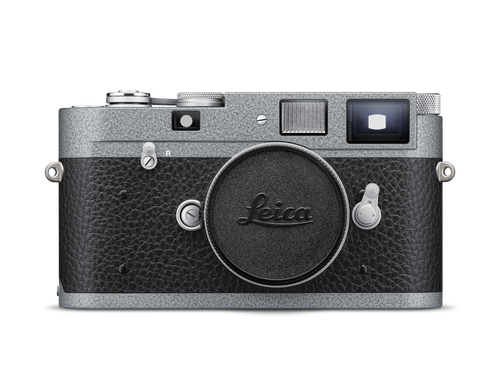
Leica M-A Hammertone
A Classic Finish. Pure Analog Photography.
The Leica M-A Hammertone brings a rare finish from Leica's history to a completely mechanical 35mm film camera. Each camera has its own distinctive texture, handcrafted in Germany. With no electronics, light meter, or battery, it is photography in its purest form.
The Essentials
A Unique Finish
The distinctive hammertone texture gives every camera its own individual appearance.
Fully Mechanical
Experience 35mm film photography without a battery, electronics, or built-in light meter.
Crafted in Germany
Solid brass construction, classic detailing, and a carefully finished surface made in Wetzlar.
01 / The Finish
No Two Exactly Alike.
The Leica M-A Hammertone features a textured finish on its solid brass top and base plates. The special painting process creates subtle variations in every camera's surface.
White engravings, traditional cross-knurled controls, a silver-colored shutter-release plate, and black vulcanite-style leatherette complete the distinctive design.
02 / The Heritage
A Finish With History.
Hammertone finishes have been associated with durable, precisely made instruments since the 1930s. Their recognizable texture became part of industrial design, particularly in Germany.
Leica has used this finish only occasionally. Historical examples include the rare Leica MD Hammertone from 1964, followed by special editions such as the Leica M9 Hammertone and Leica M-A Vienna Edition.
03 / The Experience
Photography Without Distractions.
The Leica M-A is entirely mechanical. There is no screen, autofocus, built-in exposure meter, or battery. Shutter speed, aperture, and focus are controlled manually.
This simple approach encourages photographers to work intentionally with light, composition, and timing. The M-A Hammertone retains the same proven mechanical operation as the standard M-A.
04 / Design Details
Made to Be Seen and Felt.
The M-A Hammertone combines the familiar shape of a Leica M camera with a distinctive textured finish. The silver-toned details and black leatherette create a restrained, timeless appearance.
Its tactile controls and solid brass construction connect the experience of using the camera with Leica's longstanding approach to precision engineering.
05 / The Rangefinder
See Beyond the Frame.
The optical rangefinder allows you to focus precisely while seeing beyond the edges of your composition. Bright framelines help guide your framing, and the central focusing patch provides clear manual focus control.
Compatible with Leica M lenses, the M-A Hammertone offers photographers the freedom to choose their preferred focal length and perspective.
06 / 35mm Film
A Roll at a Time.
The Leica M-A Hammertone uses standard 35mm photographic film. Choose black-and-white, color negative, or color slide film to create your preferred visual character.
Film is loaded, advanced, and rewound manually. Every exposure becomes a deliberate decision, and every finished roll is a tangible record of the photographic experience.
07 / Craftsmanship
Created With Care in Wetzlar.
The hammertone finish develops as metallic pigments and special additives interact during the drying process. Producing its recognizable texture requires careful attention to every stage of manufacturing.
Experienced specialists at Leica's factory in Wetzlar oversee the process, combining historic finishing techniques with the precision required for a modern Leica special edition.
Questions and Answers
Frequently Asked Questions About the Leica M-A Hammertone
What makes the Leica M-A Hammertone special?
The Leica M-A Hammertone combines the fully mechanical 35mm film camera with a distinctive textured finish inspired by Leica's history. It features solid brass top and base plates, white engravings, cross-knurled controls, silver-colored details, and black vulcanite-style leatherette. Every camera has subtle variations in its finish.
How is the M-A Hammertone different from the standard Leica M-A?
The difference is primarily the exterior design. The Hammertone features a special textured finish and distinctive detailing, while retaining the standard M-A's mechanical operation, optical rangefinder, and compatibility with Leica M lenses. Its core photographic functions are unchanged.
Does every Leica M-A Hammertone look the same?
No. The hammertone paint develops subtle variations during the finishing process. This gives each camera its own individual surface pattern, making every M-A Hammertone slightly different in appearance.
How is the Leica hammertone finish created?
The hammertone texture develops when metallic pigments and special additives interact as the paint dries. Small variations in surface tension create the recognizable hammered appearance. Leica has adapted this historical finishing process for its new special editions.
Where is the Leica M-A Hammertone manufactured?
The Leica M-A Hammertone is made in Germany. Its distinctive finish is produced with careful attention from specialists at Leica's manufacturing facility in Wetzlar.
Which historical Leica cameras inspired the Hammertone edition?
The edition draws on a history of rare Leica finishes, including the 1964 Leica MD Hammertone, the 2003 Leica MP LHSA, the 2011 Leica M9 Hammertone, and the 2016 Leica M-A Vienna Edition. These cameras helped establish the hammertone finish as a distinctive part of Leica's design history.
What is the difference between the Leica M-A Hammertone and M11-P Hammertone?
Both cameras share the special hammertone design, but they offer very different photographic experiences. The M-A Hammertone is a fully mechanical 35mm film camera without a battery or light meter. The M11-P Hammertone is digital, with a 60 MP full-frame sensor, 256 GB of internal memory, and Leica Content Credentials. The M-A is designed for analog photography, while the M11-P provides modern digital capabilities.
Is the Leica M-A Hammertone a film camera?
Yes. The Leica M-A Hammertone is a traditional 35mm film rangefinder camera. It captures photographs on film rather than using a digital image sensor. Film must be developed before the photographs can be viewed.
Does the Leica M-A require a battery?
No. The Leica M-A is completely mechanical and does not require batteries. Its shutter, film advance, and other photographic functions operate mechanically.
Does the Leica M-A have a built-in light meter?
No. The Leica M-A does not contain a built-in exposure meter. Photographers can determine exposure using an external light meter, a metering accessory, or their knowledge of available light and exposure settings.
How do you set exposure on the Leica M-A without a light meter?
Exposure is controlled manually using the shutter-speed dial on the camera and the aperture ring on the lens. You can use a handheld light meter or an exposure-estimation method such as the Sunny 16 rule to select settings appropriate for your film's ISO sensitivity and the available light.
What type of film does the Leica M-A use?
The Leica M-A uses standard 35mm (135) photographic film. Compatible options include black-and-white film, color negative film, and color slide film. Different film stocks offer different sensitivities, colors, grain structures, and contrast characteristics.
How do ISO settings work on the Leica M-A?
With the Leica M-A, film sensitivity is determined by the ISO rating of the film you load. The camera has a reminder dial on the back for recording that sensitivity, but it does not electronically change ISO. Photographers account for the film's sensitivity when selecting their shutter speed and aperture.
Does the Leica M-A have autofocus?
No. The Leica M-A is a manual-focus camera. Focus is adjusted using the lens focusing ring and the optical rangefinder. There are no electronic focusing controls or autofocus functions.
How does the Leica M-A optical rangefinder work?
The Leica M-A has an optical rangefinder with approximately 0.72x viewfinder magnification. Turn the lens focusing ring until the two images in the central rangefinder patch align. Bright framelines show the composition for supported focal lengths, allowing you to focus and frame photographs without electronic assistance.
What lenses can be used with the Leica M-A Hammertone?
The M-A Hammertone uses the Leica M bayonet mount. It supports compatible Leica M lenses, including current and many earlier models. Popular choices include 28mm, 35mm, and 50mm Summicron-M and Summilux-M lenses. Specialized lenses should be checked for compatibility.
What shutter speeds does the Leica M-A offer?
The Leica M-A has a mechanical shutter with speeds from 1 second to 1/1000 second in full-stop increments. Bulb mode allows longer exposures using a cable release or by holding the shutter open. Flash synchronization is available at 1/50 second.
How do you load and advance film in the Leica M-A?
Film is loaded by removing the bottom plate and opening the rear flap. Once loaded, film is advanced using the mechanical wind lever after each exposure. At the end of the roll, the film is rewound manually using the rewind control before removing the cassette.
What is the difference between the Leica M-A and Leica M6?
Both are mechanical Leica M film cameras with manual focus and interchangeable M lenses. The key difference is exposure metering. The Leica M6 includes a built-in battery-powered light meter, while the M-A has no built-in meter and requires no battery. The M-A offers a more minimalist analog experience, while the M6 provides exposure guidance through its viewfinder.
Is the Leica M-A suitable for beginners in film photography?
Yes, for photographers interested in learning fully manual film photography. The M-A provides direct control over focusing, shutter speed, and aperture. Because it does not have a built-in light meter, beginners may find an external exposure meter helpful. Leica Akademie workshops can also provide instruction in film photography and rangefinder focusing.
Technical Data
Scroll to explore specifications ↓
Camera
| Camera Type | Leica M-A (Type 127) compact 35mm rangefinder system camera with a mechanically controlled shutter |
|---|---|
| Lens Mount | Leica M bayonet |
| Lens System | Leica M lenses, 16 to 135 mm |
| Exposure Control | Manual setting of shutter speed and aperture with values from an external exposure meter or by estimation |
Flash Exposure Control
| Flash Connection | Hot shoe, accessory shoe with center contact |
|---|---|
| Synchronization | On first shutter curtain |
| Flash Exposure Control | Computer control by the flash unit or guide number calculation and manual setting of the required aperture value |
Viewfinder
| Viewfinder Principle | Large, bright, combined bright-line viewfinder with automatic parallax compensation |
|---|---|
| Eyepiece | Adjusted to -0.5 diopters Correction lenses available for -3 to +3 diopters |
| Image Field Framing | Bright-line frame pairs for 28 and 90 mm lenses 35 and 135 mm lenses 50 and 75 mm lenses Automatic display of corresponding frames when lenses are locked into the bayonet mount |
| Frame Selector | Lever enabling alternative frame pairs to be displayed in the viewfinder without changing lenses |
| Parallax Compensation | The horizontal and vertical differences between the viewfinder and lens axes are automatically compensated for in relation to the focusing distance |
| Viewfinder and Film Image | The bright-line frame size corresponds to an image size of approximately 23 x 35 mm at the minimum focusing distance for all focal lengths Focused at infinity, and depending on focal length, approximately 9% (28 mm) to 23% (135 mm) more will be captured on film than is shown in the corresponding bright-line frame |
| Viewfinder Magnification | 0.72x for all lenses |
| Long-Base Rangefinder | Coincident and superimposed image rangefinder, shown as a bright field at the center of the viewfinder image |
| Effective Rangefinder Base | 49.9 mm (mechanical rangefinder base 69.25 mm x viewfinder magnification 0.72x) |
Shutter and Shutter Release
| Shutter | Horizontal rubberized-cloth focal-plane shutter, extremely low noise, mechanically controlled |
|---|---|
| Shutter Speeds | From 1 second to 1/1000 second in one-stop increments, B for exposure times of arbitrary length |
| Shutter Release | Standard internal thread for remote-release cables |
Film Loading, Advance and Rewinding
| Loading | Manual loading after removal of the base and opening the rear flap |
|---|---|
| Film Advance | Manually, with rapid wind lever or Leicavit M Motorized, with Leica Motor-M, Leica Winder-M, Leica Winder M4-P or Leica Winder M4-2 (from article number 10 350) |
| Rewinding | Manual, pull-out rewind knob after disconnecting the advance mechanism with the R-lever on the front of the camera |
| Frame Counter | On camera top plate; automatically reset when camera baseplate is removed |
Camera Body
| Material | One-piece full-metal body with rear flap; brass top deck and baseplate |
|---|---|
| Tripod Bush | Thread A 1/4, DIN 4503 (1/4") |
| Rear Flap / Features | Reminder dial for film sensitivity |
| Dimensions | Approx. 138 x 38 x 77 mm (length x depth x height) |
| Weight | Approx. 578 g |
| Package Includes | Body cap and carrying strap |
Leica M-A Hammertone, Carrying strap, Housing bayonet cover, Cover for accessory shoe.
Limited Warranty:
Leica Camera USA (‘LEICA’) provides a three-year product limited warranty for this LEICA camera valid from the date of purchase from an authorized LEICA dealer, including the accessories contained in the original packaging which are valid for two years.
To view the full product warranties, click here.


